12/27/2004
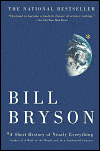 Over the past little while, I’ve been making my way through A Short History of Nearly Everything, which is a wonderful book. It’s a sort of comprehensive guide to scientific discovery through the ages, written by a guy who is not a scientist, but who interviewed some of the brainiest brains in the world and attempted to explain complex scientific theory to regular readers. Anyway, this past weekend, before I woke up Sunday morning to news of the earthquake/tidal wave, I actually read the chapter on the discovery of plate tectonics (which, amazingly, didn’t come about until the second half of the 20th century). So I actually understood a lot more than I ordinarily would have without having read so much. Some choice information that I wanted to share:
The constant turmoil keeps the plates from fusing into a single immobile plate. Assuming things continue much as at present, the Atlantic Ocean will expand until eventually it is much bigger than the Pacific. Much of California will float off and become a kind of Madagascar of the Pacific. Africa will push northward into Europe, squeezing the Mediterranean out of existence and thrusting up a chain of mountains of Himalayan majesty running from Paris to Calcutta. Australia will colonize the islands to is north and connect by some isthmian umbilicus to Asia
And then there’s this little nugget:
There are many surface features that tectonics can’t explain….Australia, meanwhile, has been tilting and sinking. Over the past 100 million years as it has drifted north toward Asia, its leading edge has sunk by some six hundred feet. It appears that Indonesia is very slowly drowning, and dragging Australia down with it.
The confluence of my reading materials and life circumstances has happened to me before. When I went backpacking through Europe between college and law school, I spent the summer reading V. by Thomas Pynchon (it’s a really dense book). One of my favorite things to do was to schedule my museum viewing during the ridiculously long siestas when everything but the museums were closed during the summer, so I would also take my book and find a seat to read for a few hours, when there was nothing else to do. Anyway, I ended up sitting in the Uffizi in Florence, in front of the Birth of Venus by Botticelli, when I ended up reading the chapter where they attempt to actually steal the Birth of Venus out of the Uffizi. It was somewhat surreal.
Let’s just hope that this is all some really big coincidence, because I just finished reading the chapter on the possibilities of an asteroid striking the earth and wiping out all of civilization.
12/26/2004
I spent a few hours today trying to figure out something coherent to say about the absolutely terrible events in Asia today, but then I realized that there’s nothing I can say that would make any difference.
Except that Atrios is going to post links to reputable charitable organizations as they come in, and I will as well.
Here’s the first one – the International Federation of Red Cross and Red Crescent Societies is providing assistance to the affected regions – I can’t find a link for direct donations for this effort in particular, but money is fungible, and the more you donate, the more they’ll be able to give (and if your specific dollars end up in Darfur, that’s a worthwhile cause as well). Please note: the IFRC is related to, but is not the American Red Cross, which is the organization investigated a few years back regarding their shady fundraising efforts surrounding 9/11. The ARC is only one member of the IFRC.
Update: Matt Yglesias links through to a couple of other resources, but it really appears that the various branches of the Red Cross are still the main vehicle for help.
12/23/2004
…and he was also 17 when he died, but this is just kind of creepy. I’m certainly not opposed to the idea of therapeutic cloning on a cellular level to create, say, a new liver if the one you’ve got is kaput, because there’s a cost-benefit analysis there that clearly (at least to me) comes down on the side of saving lives (and having lived through an era where Mickey Mantle could get a new liver after he drank his first one to death but my mother, who got an extraordinarily rare form of cancer at the age of 42 couldn’t because they weren’t willing to "waste" a liver on her because it wouldn’t completely cure her and would only prolong her life for a few years, I’m all for new solutions to the transplant problem), but there’s something about cloning a pet that, in addition to just being creepy, seems like a huge ego trip. You want a new cat? go to the shelter an adopt one of the ridiculous number of stray kittens. And then donate the $50,000 to the ASPCA.
12/12/2004
The Dance-A-Thon was last night – in the end, my friends and I only stayed for a few hours (and at least an hour and a half of that was waiting on line to buy a beer). But it was fun nonetheless. Tons of people, cheesy music, and an excuse to go to the Javits Center for the first time since I sat for the bar exam five years ago. If I’ve got to choose between 5000 people sitting for the hardest exam of their lives or at a disco, I’ll definitely pick the disco any day of the week.
No pictures though – I took a few, but there was no flash photography allowed inside the main dance hall, so they’re really all just big blurs of spotlights and people’s heads. certainly not worth taking up bandwidth for.
12/8/2004
When I read David Brooks’ column this morning, I thought there was something odd about the statistics he was presenting, but I just couldn’t put my finger on it. I kept focusing on the cultural assumptions that he places on both red staters and blue staters that are nothing more than stereotypes of both groups, and the supposed "bad influences" that he never actually delineates. Well, perhaps it’s because "bad influences" turns out to be "people who aren’t white". Media Matters and TAPPED break it down in some detail:
In his December 7 New York Times op-ed column, David Brooks cited research by Steve Sailer — a conservative who has written in defense of a group promoting eugenics — in touting a purported "spiritual" movement of people he called "natalists." Brooks defined this demographic as people who are procreating more than other Americans, moving in droves to "clean, orderly and affordable places where they can nurture children from bad influences," and leaving "what they perceive as disorder, vulgarity and danger." They account for population increases in the fastest-growing regions in the country, Brooks wrote, and politicians will take notice. But his thesis is not supported by the data — unless one limits the analysis, as Brooks apparently did, to procreative white people.
Thanks to Atrios for the links.
12/7/2004
Heh. I find this mistake in the NY Times more amusing than I probably should. They still can’t figure out how to fire Judith Miller, but when they make an obvious, amateur error they sure know how to point it out:
An editorial published on Saturday about the proposal to build a football stadium on the far West Side of Manhattan suffered from a geographic malapropism in a reference to the New York subway. The line proposed for the East Side is known as the Second Avenue line, not the No. 2 line. The No. 2 line runs up the West Side of Manhattan, as it has for, oh, 100 years. We not only approve of its existence – we applaud it. Some of us even ride it.
You just know that they got, like, a thousand e-mails pointing this out.
12/6/2004
I never ask for money on this blog, largely because it’s a labor of love, but now, here’s another labor of love – this Saturday night, my friends and I will be participating in the Move Against AIDS Dance-A-Thon. I was a little late in the whole signing up process, but I’ve now got my own page where you can make a donation to the cause. I’m trying to raise $250 by Saturday night (I’ve already donated $100 of that myself), and I’ll hope that you few, loyal readers will help me (and the GMHC) out.
12/3/2004
Yet again, the NY Times gives us some enjoyable fluff. Apparently it’s quite shocking that people would rather relax on the couch and be entertained than change diapers, cook meals, clean dishes, and drive their kids to soccer practice.
Maybe the real shock is that the scientists who conducted the study don’t understand that "emotional fulfillment" and "happiness" may not always mean the same thing. Because if these women were asked whether their children or their TV give their life more meaning, I’m pretty sure the results would be reversed.
Raising kids can be hard. You have to (and should, to a certain extent) tailor your life around them. But I’m pretty sure that most people wouldn’t choose to trade their kids in for a television (well, unless it was one of those 60-inch flat panel plasma screens – those are really cool).
And hey, while we’re on the subject, why only women? I guess it’s still just a given in the scientific community that men don’t do all this girly work anyway.
11/12/2004
Scott Peterson was found guilty of first-degree murder today. I actually wasn’t following the proceedings all that much (I think I got too wrapped up in election-related stuff to the exclusion of some tabloid fodder). But I do have a few thoughts.
- Since I didn’t follow the proceedings too much, I can’t judge the prosecution’s failures, but according to some people who followed the case pretty closely, there were many. My friend and I were actually surprised at how quickly the jury came back once it was reconstituted, and that they took such a short amount of time for first degree murder.
- However, I do tend to think that regardless of prosecutorial screwups, there was really no other answer for how this happened. I agree with Gael – It’s an Occam’s razor sort of thing, all other potential explanations are completely far-fetched. But that goes to my perceptions of the case. Were there enough holes (and there were lots of holes), that the jury should have had reasonable doubt? or at least enough doubt that would require more than two days of deliberation?
- Some people were questioning how they came back with first degree murder as opposed to second-degree or manslaughter. Frankly, I’ve thought all along that if he did it, it couldn’t be anything other than first-degree. The circumstances of the crime don’t lend themselves to anything lesser. (The hamsters turning around in my head, of course, are now also thinking that planning in the coverup of a murder doesn’t necessarily mean planning in the commission of the murder itself).
I’ve always been opposed to the death penalty, and this isn’t the case that’s going to change my mind (I have major problems with its systemic discrimination and almost random implementation, among a multitude of other reasons). I’m wondering though, even with the verdict, whether there are significant enough holes that would give the jury some pause in recommending such an absolute and irreversible sentence.
11/5/2004
…confirms my anecdotal experience. Namely, that that election procedures in New York are some of the worst in the nation. (It’s something they’ve written about before, as well). As I’ve mentioned before, I think the reason no one pays attention to it is that in federal elections, there’s really not a lot of surprise as to who is getting New York’s electoral votes (Manhattan voted over 85% for Kerry? At least I’m living in the right place (and hey, does anyone notice that the people who actually got attacked on 9/11 overwhelmingly think Bush has done a crap job?)). Heck, even Schumer won by such a large margin that they’re already speculating as to what office he really wants next (governor?).
At just my polling place on Tuesday, I experienced broken machines and confused and overwhelmed poll workers. As I wrote about in August, I’ve actually witnessed poll workers threaten to disrupt the voting process. A colleague of mine who used to be a New York City cop before he became a lawyer (and who is another Republican) has told me stories of how when he worked at elections (in New York, it’s the responsibility of the police to get the voting records back to where they get counted), they weren’t taught what part of the machine actually needed to be removed and brought in (in his case, I think they just took most of the machine, so that the election officials would be sure to have the right "part").
But local elections, particularly the "non-partisan" city council elections, are often much closer, and in a low turnout year the voting irregularities here could have a significant impact on the outcome. I seem to recall a local election from a while back (in Queens?) that needed to be decided by a coin toss because the result was an actual tie. You don’t get much closer than that.