06/16/2005
 I should probably preface this entry by mentioning that in the fourth grade, I actually made it all the way to county finals in the spelling bee.
Upon reading this book, I finally realized that I had gotten over my reader’s block. For some time, I had been buying books, putting them on my shelf and never looking at them again. I fully intended to read them, but the process seemed too daunting, so I’d pick up a copy of the New Yorker or fiddle with the design of my webpage. And today I realized that I’ve read 3 books in the past 3 weeks.
Maybe it’s the incessant computer problems, forcing me to resort to such luddite tactics as reading books, but I’ve found that point where I remember the sheer joy of finding out how a story ends.
This book was fascinating – it’s exploration of religion, faith, obsession, lies and a particularly idiosyncratic family whose lives all change when 9-year old, previously unremarkable, Eliza makes it all the way to the national spelling bee, attempting to navigate the shoals of the letter Y. Which was the letter that tripped me up in my own spelling bee attempts at age 10. I’m thinking that this might be part of the reason that I was so engrossed in the story. Then again, it could have been the incredibly engrossing story.
I always feel odd writing these mini-reviews. I don’t want to spoil the story for anyone who might pick up the book, but then I realize that these entries are incredible vague and possibly uninformative. At any rate, this was an excellent book.
06/7/2005
 I love Sarah Vowell.
Every time I read one of her books, I can practically hear it narrated in that distinctly nasal voice that one wouldn’t think was made for radio, but somehow seems perfectly appropriate whenever she appears on This American Life. And yeah, she’s part of that McSweeney’s crowd, which certainly gives an air of pretentiousness (heck, it almost stopped Monty from reading this book), but somehow continually puts out publications that I actually want to read.
Oh, and the book? pretty awesome. Vowell is completely obsessed with the minutiae of Presidential assassinations. Focusing on the first three to occur (Lincoln, Garfield and McKinley), she makes connections between the three (Robert Todd Lincoln was actually present at all three! He was like the angel of death for presidents!), and taking trips to odd medical museums, 19th-century free love colonies, caribbean prisons, and highway medians in Buffalo, her writing is infused with such excitement that it makes me want to hop a train to follow in her footsteps.
06/3/2005
 Last Saturday, I read a book in one day. It helped that I had a 3-hour haircut and a 4-hour bus ride to the parents’ house in the country – it’s amazing what you can do with a solid block of 7 hours with no television or computer access!
Anyway, the book was Freakonomics, by Steven Levitt and Stephen Dubner, and it was pretty awesome. Levitt is an economist, and Dubner is a writer for the NY Times, and they met a few years ago when Dubner was assigned to do a profile on Levitt. Levitt was getting profiled because he was the somewhat controversial guy who posited that lowering crime rates during the 90s in major urban areas were actually, at least in part, a result of the legalization of abortion by Roe v. Wade.
Although the authors somewhat jokingly claim that there is no unifying theme in the book, throughout the book they take those nuggets that we refer to as "conventional wisdom", and attempt to show that our assumptions about why things are the way they are is often wrong. We assume that A causes B simply because they move in the same direction, but we pay no attention to C, which is affecting both A and B. They’re looking for that C.
The book is engaging and enlightening, which I really never thought I’d say about a book about economics. read it.
02/18/2005
 I finished reading Case Histories about a week ago. Truly enjoyed the stories, and how they were all interconnected. The ending was a bit telegraphed, but in some ways, I think it was supposed to be – you’re making the connections in your own head as the story progresses, and you almost have to keep reading to find out if your right.
Anyway, it was good. Now my problem is that I’ve got about 12 unread books on my shelf and none of them are calling out to me. And I’ve resorted to buying New York magazine to read on the train. It’s like I’m regressing.
01/18/2005
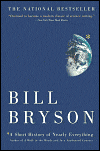 I already discussed Bryson when I got to the chapter on earthquakes, but I finally finished the entire book today (which even came as a surprise to me, as I didn’t realize that there were many, many pages of endnotes that I didn’t need to read). It’s an excellent book, and I highly recommend it. In the real world, I’ve even convinced two of my co-workers to read it.
It’s immensely readable, and Bryson really covers, at a basic level, the entire of scientific history, both on a micro (atomic structure and cells) to a macro (the universe) level. But the absolutely most entertaining part were the side anectdotes about various intellectual luminaries’ lives (and intercollegiate conflicts). It turned what could have been a dry science book into, well, an entertaining science book.
 Other books that I’ve finished recently include America: the Book, which was as funny as the hype. It’s not something to sit and read all the way through, so I picked it up at random intervals when I wanted something short (and funny) to read.
I’m also updating the reading list – I stopped off at the B&N today amongst my errands and bought a few more books (It’s the finish one, buy four philosophy which will prevent me from ever having nothing to read again in my life).
12/28/2004
Continuing my reading saga, apparently there’s another chapter about earthquakes, this time focusing on the damage they have caused:
For pure, focused, devastation, however, probably the most intense earthquake in recorded history was one that struck-and essentially shook to pieces-Lisbon, Portugal, on All Saints Day (November 1), 1755. Just before ten in the morning, the city was hit by a sudden sideways lurch now estimated at magnitude 9.0 and shaken ferociously for seven full minutes. The convulsive force was so great that the water rushed out of the city’s harbor and returned in a wave fifty feet high, adding to the destruction. When at last the motion ceased, survivors enjoyed just three minutes of calm before a second shock came, only slightly less severe than the first. A third and final shock followed two hours later. At the end of it all, sixty thousand people were dead and virtually every building for miles reduced to rubble.
250 years later, and we’re still seeing this kind of devastation. It looks like the number of those that perished will easily surpass this prior "most devastating" event (and you can try to pin some of that on population growth, but Lisbon was a major city in that era).
On that note, Doctors without Borders is also taking donations – their website has been kind of flooded with visitors as of late making it almost impossible to get through, but certainly worth it.
12/27/2004
Over the past little while, I’ve been making my way through A Short History of Nearly Everything, which is a wonderful book. It’s a sort of comprehensive guide to scientific discovery through the ages, written by a guy who is not a scientist, but who interviewed some of the brainiest brains in the world and attempted to explain complex scientific theory to regular readers. Anyway, this past weekend, before I woke up Sunday morning to news of the earthquake/tidal wave, I actually read the chapter on the discovery of plate tectonics (which, amazingly, didn’t come about until the second half of the 20th century). So I actually understood a lot more than I ordinarily would have without having read so much. Some choice information that I wanted to share:
The constant turmoil keeps the plates from fusing into a single immobile plate. Assuming things continue much as at present, the Atlantic Ocean will expand until eventually it is much bigger than the Pacific. Much of California will float off and become a kind of Madagascar of the Pacific. Africa will push northward into Europe, squeezing the Mediterranean out of existence and thrusting up a chain of mountains of Himalayan majesty running from Paris to Calcutta. Australia will colonize the islands to is north and connect by some isthmian umbilicus to Asia
And then there’s this little nugget:
There are many surface features that tectonics can’t explain….Australia, meanwhile, has been tilting and sinking. Over the past 100 million years as it has drifted north toward Asia, its leading edge has sunk by some six hundred feet. It appears that Indonesia is very slowly drowning, and dragging Australia down with it.
The confluence of my reading materials and life circumstances has happened to me before. When I went backpacking through Europe between college and law school, I spent the summer reading V. by Thomas Pynchon (it’s a really dense book). One of my favorite things to do was to schedule my museum viewing during the ridiculously long siestas when everything but the museums were closed during the summer, so I would also take my book and find a seat to read for a few hours, when there was nothing else to do. Anyway, I ended up sitting in the Uffizi in Florence, in front of the Birth of Venus by Botticelli, when I ended up reading the chapter where they attempt to actually steal the Birth of Venus out of the Uffizi. It was somewhat surreal.
Let’s just hope that this is all some really big coincidence, because I just finished reading the chapter on the possibilities of an asteroid striking the earth and wiping out all of civilization.
11/17/2004
Ordered a few new books that are on their way, but probably won’t arrive before Thanksgiving (why is it that I always pick at least one book that doesn’t qualify for same day delivery from Barnes & Noble?). Anyway, I’m moving more towards fiction these days, because I’m all politicked out:
- Case Histories, by Kate Atkinson;
- Jonathan Strange and Mr. Norrell, by Susanna Clarke; and
- Runaway: Stories, short stories by Alice Munro
That should keep me busy for some time.
11/9/2004
Finished reading Life of Pi the other day, and it was fantastic. It had been sitting on my shelf for a while – one of those books that I picked up on a spree at the local Barnes & Noble, which then started gathering dust when I got distracted. Well, it was worth the wait. I found myself taking the bus instead of the subway so that I’d have longer commute times during which I could read. And the end…well, I don’t want to spoil it for anyone, but I’m still thinking about it.